Why should a distributor use ERP Software?

on March 18, 2022


Defining the Distribution Industry

A distribution company may purchase items in bulk from manufacturers and resell them to retailers or other resellers who sell to customers, or it can acquire things from manufacturers and sell straight to consumers or companies. A distribution company also performs responsibilities for manufacturers such as logistics and warehousing. Depending on the deal with the manufacturer, the pricing of a distribution firm may be cheaper or more than wholesale rates.

For a wholesale distributor like your company, you’ll need ERP software with strong capabilities in specialized features that directly solve the business difficulties unique to your sector.

As a result, you’ll need to choose your ERP software wisely.
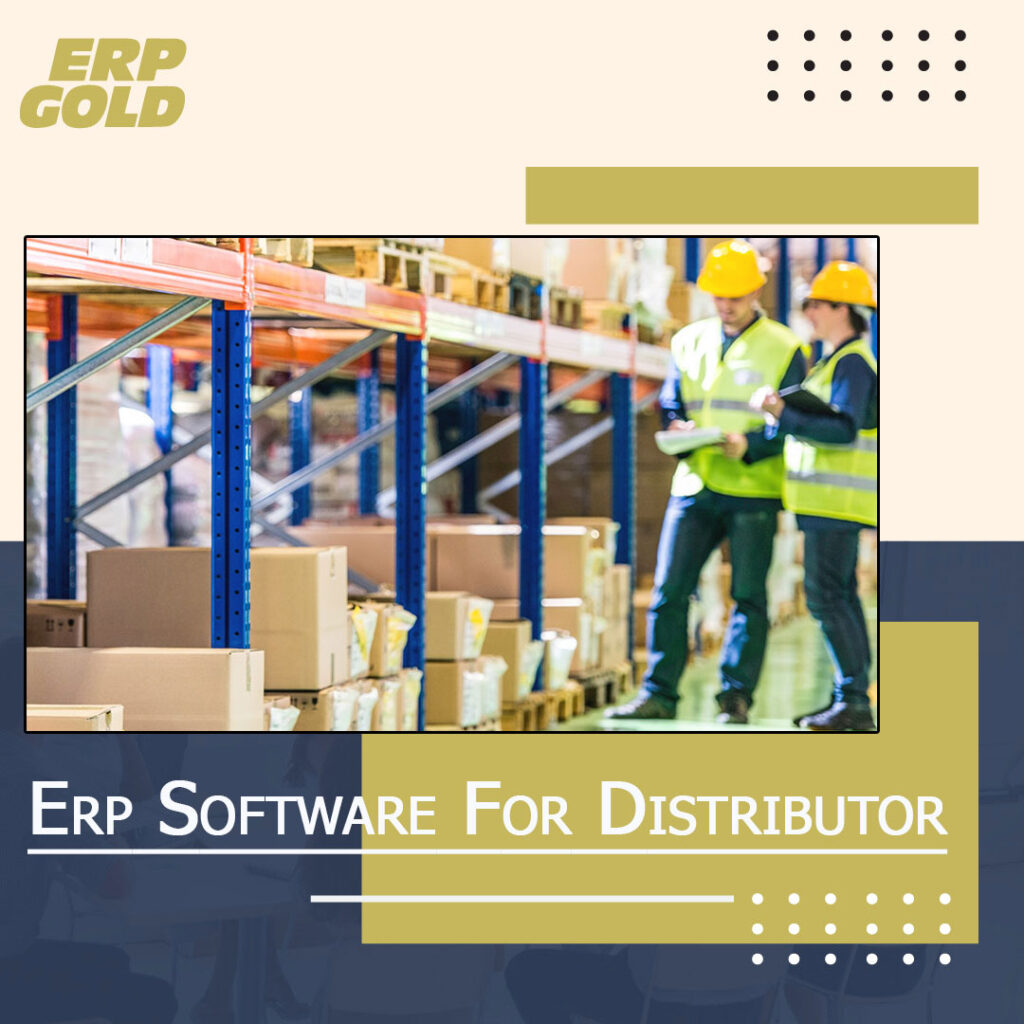
 

erp software for distributors<br /> better distributor management system<br /> best erp for distributor

erp software for distributors

What does ERP Software do For Distribution Business?

Enterprise Resource Planning or ERP software is a set of computer applications that companies use to streamline and automate business operations.

When you’re in business, it doesn’t matter what business you’re in – products are king. And the product is only as great as the system that delivers it. ERP software is an enterprise-wide computer program that manages information from the initial point of sale through to accounting and inventory management.

An ERP system can be easily integrated with a company’s other systems and applications, including supply chain management, CRM, e-commerce, SCM and MES.

These are some of the important characteristics of ERP software that may help your wholesale distribution firm overcome industry-specific issues.

Advantages Of IMS for Wholesale or Distribution Business.


1 :Inventory Management Features Can Help You Manage Your Procure-to-Pay Cycle

You should have just enough stock of a product on hand to match current client demand. Too much and you’ll incur extra storage expenses and risk the product’s obsolescence, while too little will result in stock-outs for your company and consumers turning to your rivals.

To guarantee that you have the correct quantity of stock for your purposes, you’ll need ERP software with inventory management features that provide real-time visibility into inventory movements. ERP software with a powerful inventory management feature must have  complete feature set that aids in the management of your procure-to-pay cycle, including but not limited to the following steps:

  • Creating requisition orders
  • Creating purchase orders (PO)
  • Syncing goods receipts with warehouse inventory levels
  • Processing accounts payable (AP) invoices
  • Recording transactions in ERP software for future report generation

With the extensive inventory management features of ERP software like SAP Business One, you’d be able to fulfill client orders on schedule while avoiding missed revenues and expenses associated with retaining extra inventory.

2: Better Customer Service to Clients

Retaining your client base’s long-term business is critical to making your wholesale distribution firm viable; therefore you must be able to keep them coming back for your services. And in order to do so, you’ll need to understand your consumers’ requirements and preferences as well as possible in order to better cater to them.

This means you’ll need a system that can collect important data from every connection with your customers – whether it’s customer interactions, sales conversations, or transaction histories – and provide the insights that will allow you to give them with a customized service. While these duties are the responsibility of customer relationship management (CRM) solutions, an integration may supplement the CRM solution’s functionality with complementing features in ERP software.

For example, ERP software may serve as a single repository for key customer data and synchronize your CRM solution’s customer connections with other applications such as Microsoft Outlook, making it easy to access them as required.

3: Better Order Fullfilment

Obtaining orders from consumers is merely the first stage; the aim of your wholesale distribution firm is to be able to properly fulfill these orders.

And, with the advent of e-Commerce and online shopping in recent years, it’s quite possible that you’ll have a large portion of your client base comprised of firms in this area.

Your wholesale distribution company will need to employ pick and pack fulfillment procedures in your warehouses to best meet their unique set of online retail-specific demands.

This implies that the ERP software you choose should preferably have built-in warehouse management system (WMS) capability

4: Lot Tracking And Better Inventory Tracking

Your wholesale distribution company may be forced to conduct a product recall for a variety of reasons. For example, if your company handles a product line that was discovered to have a significant design problem, or if foodstuffs were contaminated anywhere along the supply chain, you’d have to recall these items in order to preserve regulatory compliance.

However, in order to properly perform a product recall, your company must be able to trace the position of your inventory at any point along your supply chain.

That means you’ll need ERP software with lot tracking features, which will provide you with the end-to-end insight you’ll need to determine where the issue with your items is.

Final Thought

ERP Software Is Critical in Meeting the Challenges of the Distribution Industry. Because of the industry’s particular mix of business difficulties, wholesale distributors like your company must consider them when picking which software solution – including ERP software – to install.

Do you want to get more customers, improve your product mix and streamline your operations? Then use ERP Gold software! It is best for wholesalers or distributors who need a system that gives complete control of their inventory and orders. These systems can be customized to your business’s specific needs. Request a demo today!
read more
AdminWhat is Manufacturing accounting software ? Elaboration

Important Inventory Management Tips for SMBs

on March 16, 2022


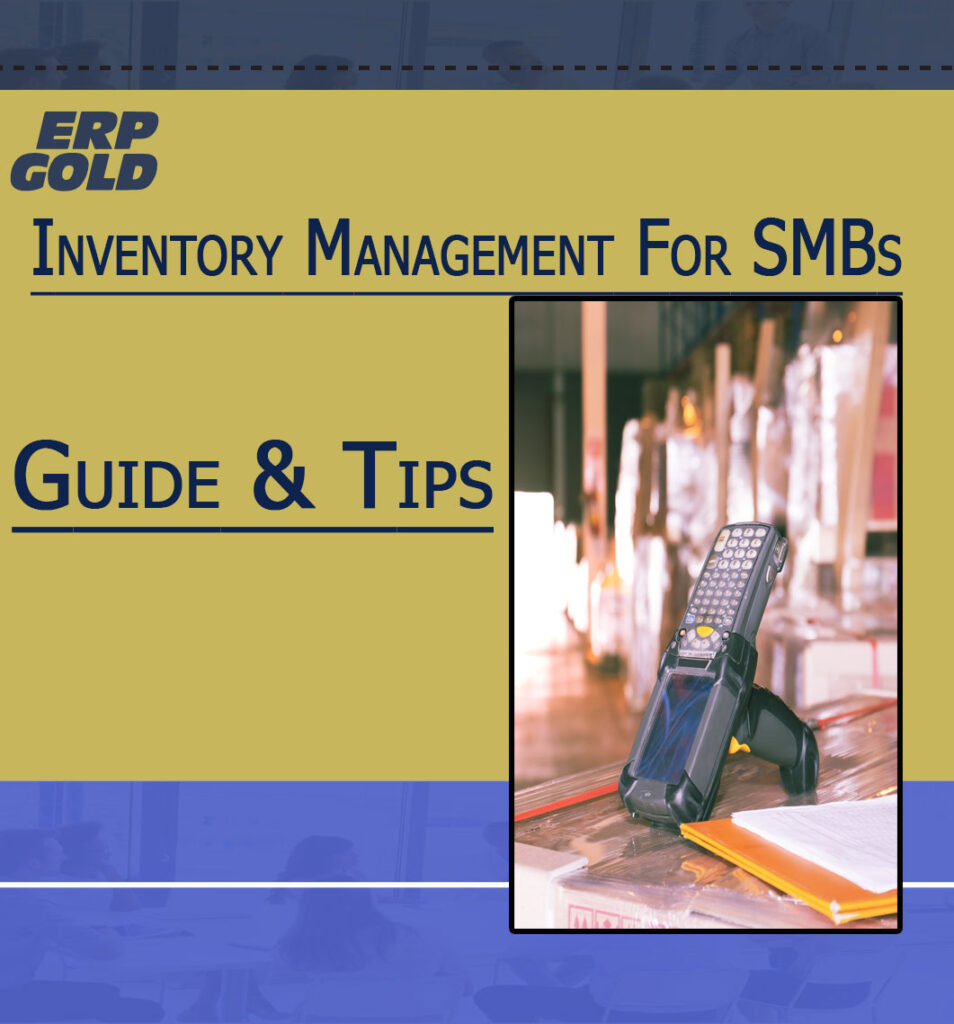
What Is Inventory Management?

The process of ordering, storing, utilizing, and selling a company’s inventory is called inventory management. This comprises a raw material, component, completed product management, and storage and processing of such commodities.

  • Inventory management encompasses the complete process of managing inventories, from raw materials to finished goods.
  • Inventory management strives to effectively streamline stocks to minimize both gluts and shortages.
  • Just-in-time (JIT) and materials need planning are two primary strategies for inventory management (MRP).

It is difficult for small businesses to survive and prosper in a competitive business environment. Similarly, other elements are to consider for start-ups trying getting off to a good start.

Let’s look at some inventory management suggestions for small companies and start-ups and some essential business best practices that SMEs need to survive.

Inventory management tips for smbs, Important inventory management tips for small and medium business,Inventory tips for smbs, Keeping track of inventory manually,Let us select the best inventory management software for your small company.

The first step that every small or new firm can take to guarantee excellent inventory management is to choose a solid inventory management software platform.

With a slew of recent advancements in cloud computing technologies, even small firms with limited resources may have access to cutting-edge software via a monthly subscription.

Software-as-a-Service (SaaS) is transforming how organizations access their software platforms and their data. This is a terrific approach to reduce IT expenditures since SaaS providers host the program and conduct updates and upgrades.

1: Tracking with precision

Inventory tracking throughout all supply chain nodes is a critical component of inventory management—the more precise the tracking, the better. Inventory monitoring accuracy is a vital component of efficient and cost-effective inventory management.

The most excellent software solutions operate in real-time, often using bar-coding and mobile technologies. This allows for the most precise and relevant inventory management possible.

2: Streamline and optimize from the beginning.

Streamlining and optimizing inventory operations does not have to wait till your firm is established. When combined with effective inventory management software, these strategies may be used from the outset, saving you both time and much-needed money. Consider employing an inventory management specialist to help you start if you have the funds.

3: Carry out, frequent manual stock counts.

While the finest software uses real-time stock accounting, frequent stock counts are still required, particularly if some of your items have a shelf life. Manual stock counts allow you to reconcile your stock with what stock you believe you have, and this is the only reliable method for detecting outdated, stolen, or damaged material.

4: Take into account software that interfaces with other platforms.

Choosing inventory management software with integration capabilities is an excellent way to protect small firms from complicated and inefficient operations. If you want to utilize accounting, point-of-sale, or warehouse management software, search for integration possibilities that will make your life simpler. To have a long-term company, there must be some palpable reality of harmony between the many aspects of your systems and procedures.

5: Early standardization is recommended.

It’s natural and acceptable for new or small firms to learn best practices via trial and error. This isn’t inherently bad, but it would be much better to have some intentionally realized uniformity. Each process may be examined and planned ahead of time for increased efficiency and process harmony.

Everything from orders placed and goods received to how stock counts are performed and sales are rung through may be evaluated and standardized. While this may alter over time, having a strategy in place is preferable to having no plan at all.

6: Organize your warehouse or stockroom.

Many money might get unnecessarily tangled or lost in the stock room or warehouse. It is advantageous to plan ahead of time. When a warehouse is well-managed, it may run streamlined, allowing for better inventory use and reduced stock waste. For example, if two items or components are often used together, they must be close to each other to optimize procedures.

Ending thought

Your company’s inventory management plays a crucial role in your success. Make sure you keep track of all your stock and know where and how much of it you have. The last thing you want is to realize that you’ve run out of something when a customer places an order for it. See the horrible you will face then. Thanks


read more
AdminWhat is Manufacturing accounting software ? Elaboration

SKU Rationalization as a Tool Of Inventory Management

on March 10, 2022

What Is SKU Rationalization?


SKU Rationalization is a process of reducing the number of stock-keeping units (SKUs) in a product portfolio to improve inventory management and reduce cost. This also results in financial benefits by increasing sales, improving operations, reducing costs, and increasing profitability.

Anyone involved in inventory adjustments should have a thorough understanding of their company’s strengths and weaknesses. SKU code rationalization is especially important if you sell on an online marketplace where profitability is dependent on high order volume.

SKU Rationalization as a Tool of Inventory Management Technique
SKU rationalization is a cross-functional inventory management technique used to increase profitability.It matters a lot in inventory management because changes to the product catalog and SKUs directly impact days inventory outstanding (DIO), which is the number of days inventory is held before it is sold. The longer you keep inventory, the higher your carrying cost.

Businesses that use SKU rationalization can be confident that they are on the right track. Time to focus on your inventory requirements will help your business thrive, and profits grow.

Objectives for SKU Rationalization

Now that you understand why businesses use SKU rationalization, you can develop your strategy. This is one area of business where diligence is more important than creativity, so it’s beneficial to learn from what others have done. On the other hand, a little out-of-the-box thinking gives a strong strategy the extra boost it needs to succeed.

The following are the top seven objectives for an effective SKU rationalization methodology:

  • Revamp your marketing strategy. Although it may appear to be a disjointed approach, reviewing your eCommerce marketing strategy or wholesale marketing plan is critical. The product purchases you make are influenced by the type of customer you attempt to reach. If your company is purchasing goods that do not increase sales, your marketing is likely ineffective. Examine your core marketing approaches and the types of buying patterns they produce.
  • Examine recent sales figures. Obtain sales records for the previous 90 days before refreshing SKU counts. This means you’ll make data-driven decisions about which SKUs to keep rather than simply following your gut instinct. While you probably know your business well, the more successful you become, the more difficult staying in touch with your customers’ needs. You might be surprised to learn which products are performing well and should be phased out.
  • Ask your customers what their favorite products are. After your sales figures have revealed the most significant trends, ask your customers what they are most interested in. Allowing your buyers to directly influence future inventory has a far greater impact than you may realize. This is especially important if you sell online, as BlueCart eCommerce does. It also gives customers the option to make specific product requests. Your survey results will increase your sell-through rate, fill rate, and inventory turnover ratio over time.
  • Reclassify all of your products. This is the difficult part. It’s much easier to reclassify products when you know which ones are succeeding and which ones aren’t. Sort SKUs into keeping, unsure, removing, and new products to add the same way you would with spring cleaning. Unsure products can be reevaluated later based on seasonality or kitting relevance. The new products must be integrated into all aspects of your business, from financial forecasting to your warehouse management system.
  • Estimate the rate of sales cannibalization and switching. These terms can be perplexing if you’ve never heard them before, so let’s go over them one by one. When an existing product loses sales due to the introduction of a new one, this is called sales cannibalization.
  • Revisit your financial projections. Regarding financial analysis, updating financial and business goals is a critical component of SKU rationalization. Sales will fluctuate whenever you change the products you offer and how much they cost. Higher-value SKUs should result in more sales in most cases, but you should test this on a trendline first. If future sales do not exceed the new cost of goods sold promptly, you will need to cut costs elsewhere.

Benefits from SKU Rationalization.

Having a couple of boxes of unorganized merchandise may be unavoidable at times. However, if you have several boxes taking up unnecessary space, this will impact your daily efficiency. Your warehouse process flow shows where each pallet should go, but your company’s needs may change over time. You can also greatly simplify warehouse staff members’ work by keeping a list of only valuable SKUs.

  • Profitability has increased.

Making more money is one of the most significant advantages of SKU rationalization, and you can scale faster if you only keep products that drive business growth. Thorough SKU rationalization also reveals consumer trends, allowing you to stock more of the buyers’ products. This results in a snowball effect in which your most profitable products lead to exponential growth and brand relevance.

  • Inventory Write-Offs Reduced: By removing slow-moving goods from your inventory profile, you may reduce inventory reserves and future write-offs, which will have a direct effect on EBITDA.
  • Vendor Rationalization: By identifying your strategic items, you may be able to eliminate the requirement to source from several suppliers. Purchasing more items from fewer suppliers might help you lower unit costs by purchasing in larger amounts from those providers. By developing deeper connections with fewer providers, you may be able to negotiate lower rates and/or payment conditions. This has the potential to boost both gross margin and working capital.
  • Improved Working Capital Metrics: Increasing inventory turnover may be achieved by optimizing your SKUs. Inventory will spend less time on the warehouse shelf and convert into sales more quickly.


  • Increased Access to Capital: Many businesses employ asset-backed loans, with accounts receivable or inventory serving as security. When assessing line of credit limits, lenders often eliminate past-due receivables and outdated goods from their calculations. Having access to money during tough times will be vital to satisfying responsibilities to both workers and consumers.
  • Improved Customer Satisfaction: Maintaining a better inventory mix will result in higher customer satisfaction due to fewer stock-outs and more efficient order delivery. Strong customer connections may help your business survive even in challenging economic times.
  • Reduced Labor Costs: Eliminating slow-moving things means spending less time storing and maintaining slow-moving products and repurposing that labor to transport orders to consumers, shortening order fulfillment time.
  • Inventory Write-Offs Reduced: By removing slow-moving goods from your inventory profile, you may reduce inventory reserves and future write-offs.
  • Vendor Rationalization: By identifying your strategic items, you may be able to eliminate the requirement to source from several suppliers. Purchasing more items from fewer suppliers might help you lower unit costs by purchasing in larger amounts from those providers. By developing deeper connections with fewer providers, you may be able to negotiate lower rates and/or payment conditions. This has the potential to boost both gross margin and working capital.
  • Improved Working Capital Metrics: Increasing inventory turnover may be achieved by optimizing your SKUs. Inventory will spend less time on the warehouse shelf and convert into sales more quickly.

Conclusion

As the company continues to grow it’s important to ensure a healthy bottom line. This can be achieved through SKU rationalization, where we look at each product/service and its contribution towards the overall business. So keep updated thanks.

read more
AdminWhat is Manufacturing accounting software ? Elaboration

Types of Inventory | Complete Guide for Small Business

on March 09, 2022


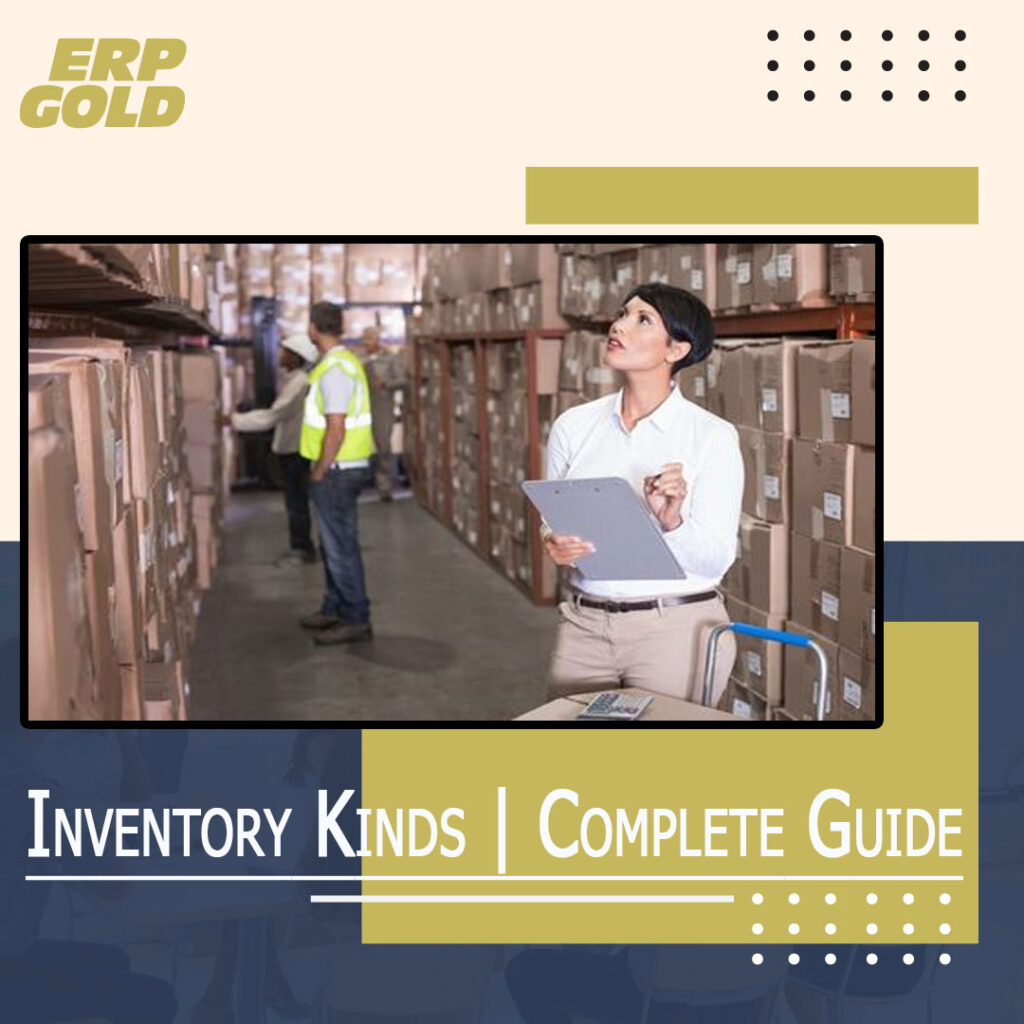
inventory kinds

inventory kinds

The Inventory is the most valuable asset of any company. It is the storehouse for all raw materials and finished goods required for business production. Types of inventory are an important concept in accounting, finance and management. In this article, you will find out types of inventory which will help you to get a clear idea about different kinds of inventories available in business world.

What Exactly Is Inventory?

A stock or store of things is described as inventory. A business maintains these commodities to meet demand and achieve its goals. Without an adequate inventory, the company may not know how much product (or services) it has on hand and won’t be prepared to meet orders—or even have the capability to do so.

Let’s say you run a business, and a customer walks in seeking new jeans. If you ran out of jeans yesterday and haven’t replaced them, that consumer may decide to purchase somewhere else, and it’s logical.

Furthermore, if you’re a manufacturer, you’ll need to keep various inventories on hand to keep things ‘going smoothly.’ You’ll also need to keep a stock of finished goods on hand to meet demand.

The Different Types of Inventory

There are various sorts of inventory that business owners and managers should be aware of regarding supply and demand. Understanding the different inventory forms can help you manage, plan, and budget more effectively, and you’ll be able to meet demand and succeed in the marketplace as a result.

1) Starting Materials

Raw resources are essential to every company’s survival, and they’re created from the same materials that your company uses to make its products.

If you run a lemonade stand, for example, the raw materials you’ll need are water, sugar, and lemon. You can’t make the beverage you market and sell without those raw elements. Customers who are satisfied (and no longer thirsty) are those who have lemonade on hand.

You can’t accurately anticipate what you’ll create over the following quarter or year if your organization doesn’t have a system in place to track its raw material supply.

2) In-Progress (WIP)

Work-in-progress (WIP) refers to all of the pieces that are currently being processed in a system, including:

  • Materials required
  • Components (components)
  • Assemblies
  • Subassemblies

Raw materials that have been released for first processing are frequently included in WIP. It also includes the full production process. Let’s say you’re the owner of an auto repair shop. Brake pads would be on your to-do list.

Expert tip: ERP software task feature would be ideal for keeping track of the status of your staff that is responsible for changing the brake pads on a car in your shop.

3) Delivered Goods

As you might expect, finished goods inventory includes any complete products that are now ready to be marketed and sold. The packaged and boxed ice cream cones, for example, would constitute finished goods inventory if your restaurant sells pre-packaged ice cream treats.

4) Materials for Packing

As the name implies, the packing material is the inventory you use to box and send your final items. Packing material is usually divided into three types:

  • Initial packaging
  • Back-up packing
  • Other packing materials

The box, bag, or other material that encloses your product while on retail display is considered primary packing material. Customers’ boxes or bottles from the grocery store shelf are your principal packing material if you sell laundry detergent.

The box, bag, or other material you employ for convenient storage and transportation of your product is secondary packing material. Using the laundry detergent example, the secondary packing material is the large box that carries four bottles of your goods for bulk storage and distribution to retail locations.

Miscellaneous packaging material includes everything else you use to store and transport your product, such as:

  • Protective bubble wrap
  • Peanuts made of foam
  • Pallets
  • Wrapping pallets
  • Labels

Packing materials may not appear to be a high cost at first sight. However, your company uses a significant volume of these supplies daily, and the costs will quickly mount if you don’t keep a close eye on this stock.

5) Back-up Stock

You can assign particular types of inventory to protect against supply-and-demand risks, low delivery reliability, and poor-quality components with good monitoring, tracking, and management. Safety stock is the term for this type of inventory cushion (or buffer inventory).

The amount of product you keep on hand as safety stock exceeds your organization’s requirements to meet regular demand.

You can avoid the following with safety stock:

  • Stock shortages (when an order cannot be filled from existing inventory)
  • Backorders
  • Making the consumer wait for the next manufacturing cycle
  • causing the client to look for the product elsewhere

When your company doesn’t have to deal with these problems, it can focus on providing better customer service—getting the product into customers’ hands when they need it without making them wait—and, as a result, more customer satisfaction.

A large amount of safety stock may be required depending on the type of business you run and the industry in which it operates. Other companies can get away with having very little or no safety stock. Everything is dependent on the market and how soon you can make (and deliver) a high-quality product to your clients.

A thorough examination of your process, employees, and fulfillment schedule will reveal whether or not safety stock is appropriate for your company.

6) Inventory Smoothing

Smoothing inventory (also known as anticipating inventory) occurs when a producer acquires and stockpiles products or supplies over current needs in preparation for a future event.

Businesses do this to “smooth” out the peaks and valleys of seasonal, shifting demand and maintain a consistent output. This is how it goes.

In the months proceeding up to the start of a new school year, a pen manufacturer will stock up on components, supplies, and finished stock (when demand is at its highest). The producer then gradually lowers the extra inventory without increasing manufacturing time during the back-to-school rush.

The manufacturer can save money in various ways by storing smoothing inventory, such as:

  1. Keeping employees occupied during sluggish months
  2. Reducing the number of temporary layoffs
  3. Stocking up on goods when they’re on sale
  4. Reducing labour costs such as hiring, on boarding, training, and other expenses
  5. Reducing the number of overtime hours required due to increased productivity.
  6. Keeping the plant from shutting down or idling

If your firm experiences a seasonal spike in demand, building this type of inventory ahead of time will help keep your process going smoothly and efficiently throughout the year.

7) Decoupling inventory

In a production context, every machine produces at a different rate. In the manufacturing chain, one or two pieces of equipment may run several times faster than other pieces in front of or behind them. Machines must occasionally be shut down for repairs or maintenance.

Manufacturers can maintain workflow despite these changes in activity and production time by keeping decoupled goods in stock.

Parts, materials, and finished goods waiting to be used by the next machine in the chain are referred to as decoupling inventory. Consider it a kind of shock absorber protecting the manufacturing process against production inconsistencies caused by differences in run time, machine breakdowns, or maintenance.

This type of inventory reduces the company’s reliance on the production line’s sequential nature, as Machine B doesn’t have to wait for Machine A to finish before they can begin. Even if Machine A is down for repairs, the operator of Machine B can pull parts from the decoupling stock.

The more decoupled inventory a company has in different stages of manufacturing and delivery, the less coordination it will need to keep things moving well.

8) Perform a cycle

Economic order quantity theory produces cycle inventory as a consequence (EOQ). EOQ seeks to strike a balance between inventory and machine setup costs.

Inventory costs rise when your company orders a large number of parts for a single large manufacturing run, while machine setup costs fall (because you only have to set up the machine once).

On the other hand, inventory costs drop when your company orders a limited number of parts for a series of modest manufacturing runs. Still, machine setup costs rise (because you have to alter the machine for each run).

The purpose of cycle inventory is to align these two charges and lower the total cost of the production run. This is accomplished through cycle inventory, which orders material in large quantities rather than as-needed.

9) MRO (Maintenance, Repair, and Overhaul)

MRO goods, or maintenance, repair, and operational supplies, are commodities used to keep the production process running smoothly. These items are frequently an important part of the manufacturing process but do not appear in the final product.

Gloves, packing materials, tools, and other MRO items are examples. MRO items inventory includes staples, pens and pencils, copier paper, and toner, as well as all of the small bits that keep the wheels turning.

10) Providers

Service inventory covers the monitoring and administration of all other types of inventory in the manufacturing process, which is critical to corporate success. In some ways, it’s the “humanized” version of MRO goods.

ERP software’s extensive scheduling system makes it simple to keep track of your service inventory by allowing you to easily plan your staff’s work schedules. Scheduling becomes much easier and more convenient as a result!

Your company will relax knowing that the manufacturing process is ongoing and that your personnel will always be available when needed. That’s what you call service inventory, right there!

11) Inventory in Transit

Businesses that need to convey commodities or resources from one location to another rely on transit inventories. Merchandise sent by truck or rail from a regional warehouse to your retail location can take days (or even weeks) to arrive.

When it comes to supply and demand, inventory in transit must be taken into account, as well as the deadlines for meeting those requests.

12) Average Inventory

Theoretical inventory aims to balance (equalize) the rates of entry, processing, and outflow into a single ideal operation. To that end, theoretical inventory specifies the average inventory required for specific manufacturing run under the assumption that no production items (or work-in-progress items) must wait in a buffer (e.g., decoupling inventory).

Theoretical inventory, to put it another way, is the bare minimum of inventory required for a product to pass through the manufacturing system without being held up.

Unless your company operates a single production system (e.g., one machine), theoretical inventory will always be a pipe dream since there will always be some inventory in the system (e.g., transportation, decoupling, MRO, etc.). You can still utilize this type of inventory to plan manufacturing runs and anticipate peak demand.

Unfortunately, simply comprehending the many sorts of inventory for business is frequently insufficient. Your company should have a good employee/inventory management system to make the most of the various inventory systems.

Inventory Control Is Critical

Inventory management is critical for the success of any business, whether it’s a one-person food cart, a catering firm, or a multi-national retail chain.

Even if your inventory is small, properly managing it can help you avoid the following problems:

  • Stock that has died
  • Excessive taxation
  • Costs of storage
  • Contamination (where applicable)
  • Issues with space

When you reduce the costs associated with inventory, you save money and increase your company’s cash flow. Essentially, you free up funds that would otherwise be lying on a shelf, capital that you may utilize for more important expenses.

Successful inventory management saves you time in the long term, which you could spend on other customer-focused operations. Inventory management, together with shift planning, labor tracking, communication, and distribution technologies, adds to the efficient functioning of your organization, regardless of the sorts of inventory you deal with.

To make this achievable, businesses need a single place to submit information on corporate activities, processes, and statuses. The ERP software news feed gives a readily accessible location for all employees. Companies may share updates and news with multiple groups of individuals, bringing teams together and keeping everyone on the same page.

Maintaining a good supply and demand cycle necessitates seamless communication and management systems. This, combined with a strong foundation and management team, is essential for effectively tracking your company’s many sorts of inventory.

Tracking your company’s inventory and supply and demand cycle will help you manage your organization more successfully in various industries, from retail and service to healthcare and non-profit. Soon enough, you’ll realize that running a business is as simple as producing lemonade, as we described earlier in the essay.

Ending Thought

Visit ERP software website today for more free resources to help you better manage your business, organize and plan your workforce, and track and analyze labour expenditures. If You want Inventory automation, drop us a line !!!


read more
AdminWhat is Manufacturing accounting software ? Elaboration

Latest Technology to Track Inventory Effectively in 2022

on March 09, 2022

Inventory Tracking, inventory tracking devices, inventory tracking technologies

What is Inventory Tracking?

Inventory tracking is how a company continually monitors its entire inventory. Inventory may be defined in various ways, although it is most typically used to refer to raw materials, unfinished things, and ready-to-sell commodities.

You may access data such as your precise inventory levels, the location of each item or SKU, updated delivery statuses, and other inventory-related information with inventory tracking. Inventory monitoring occurs in every firm that works with inventory, such as manufacturing and production organizations, warehouses, retail shops, and so on.

Inventory Tracking: Why it Is Important . . . ?

Typically, inventory monitoring systems can keep track of the following data:

  • Stock levels have been updated.

This number indicates how much of each item you presently own. It’s critical to maintain this data up to date to know whether you have adequate stock for your business activities, whether they’re creating new things or completing client requests. Furthermore, your stock levels serve as a foundation for the other recorded data.

  • Inventory locations Identification

In the best-case scenario, we should not keep your inventory in a single area for an extended period. (If it does, it has either become slow-moving or dead stock.) When goods enter your warehouse, it is sorted and categorized, then stored, and finally retrieved and transferred to the next step of your supply chain. Because your inventory isn’t kept in a permanent area, it’s critical to maintain track of its whereabouts, so you know where to look if you need it.

  • Inventory Precision – KPI

This is a key performance indicator (KPI) that refers to the ratio of inventory that has been monitored to inventory that is physically present in your possession. Both numbers should ideally be the same. However, there may be variations due to theft, damage, miscalculations, and supplier shortages.

Inventory accuracy will reveal the magnitude of the differences. Inventory accuracy, like stock levels, is critical to the seamless operation of your company operations.

  • Inventory Tracking Helps in identifying Carrying expenses

This is the entire amount of money spent on storing, keeping, and owning goods. This covers the amount you spend on rent, labor, storage, and related expenditures, as well as security. Carrying costs may inform you how long your company can continue to hold this inventory before it starts to cost money.

Slow-moving inventory and dead stock are two major contributors to high carrying costs, so if you want to cut those expenses, you’ll need to find a strategy to get rid of or sell the things.

  • Inventory valuation

When a company produces its financial accounts, this procedure determines the worth of unsold inventory. Inventory valuation assigns a financial value to your residual stock, which must be added to your balance sheet. This might also aid in the calculation of your inventory turnover.

Inventory turnover refers to the frequency with which your inventory is sold. A greater figure indicates better sales, whereas a lower value indicates worse sales. Inventory turnover can inform you how well your company is performing and if your sales strategy needs to be tweaked. To determine yours, use our free inventory turnover calculator.

  • Rearrange levels

A reorder point or level is the quantity of stock left for a certain item to be renewed or refilled. Reorder points are critical for avoiding stockouts (where a seller runs out of stock).

Inventory Tracking Technologies Being Used in 2022

Many of the problems that companies experience, such as running out of stock, having excess stock (which means tied-up capital), or having outmoded products or spoiling, are the consequence of inadequate inventory management. You boost your bottom line when you employ inventory management software with inventory control technologies. Using technology to supplement inventory management allows your company to keep on top of things by simplifying the ordering and monitoring process throughout a product’s sales cycle.

  1. RFID (Radio Frequency Identification) Technology

RFID is an abbreviation for “radio-frequency identification,” and it refers to a technique that uses radio waves to collect digital data recorded in RFID tags or smart labels (described below). RFID is comparable to barcoding because data from a tag or label is taken by a device and stored in a database.

On the other hand, RFID provides several benefits over systems that employ barcode asset tracking software. The most significant difference is that RFID tag data may be read even when the tag is not in direct view, while we must align barcodes with an optical scanner.

RFID is one of a category of technologies known as Automatic Identification and Data Capture (AIDC). With little or no human interaction, AIDC techniques automatically recognize items, gather data about them, and input that data straight into computer systems. RFID systems do this by using radio signals.

  • LiFi (Light Fidelity) Technology

LiFi is a wireless communication system that uses light to convey data and location. LED bulbs are capable of transmitting visible light. In warehouses and factories, providing a wireless connection for many robots and electrical equipment is a difficult task.

LiFi has significant benefits over WiFi in certain circumstances and may be employed as a dependable wireless networking solution. Furthermore, visible light communication may enable precise 3D location for robots, drones, and other devices in warehouses and factories where indoor positioning and navigation are critical.

  • Barcodes system

We may find barcodes in various places, including identity cards, mail, and products purchased at a shop. For identifying reasons, a little picture of lines, bars, and spaces is mounted to practically anything you can think of.

Barcodes, in particular, employ a series of vertical bars and spaces to represent numbers and other symbols; a barcode normally consists of five parts:

  • A quiet zone
  • A start character
  • data characters (often containing an optional check character)
  • A stop character
  • Another quiet zone.

When we are using barcode scanners, bar-coding improves efficiency and production in various sectors. Laser beams are used to scan barcodes and convert the reflected light into data, which is subsequently sent to a computer for action or storage.

Most people are acquainted with barcodes and barcode readers in supermarkets and retail businesses. However, barcodes are handy in various uses, ranging from inventory to book checkout to monitoring bees for study. In retail environments, barcode readers are often coupled to computers, but they are also mobile and portable for other tasks, such as scanning barcodes in warehouses and monitoring inventory.

Robotics Technology

New robots technology has quickly become one of the most sought-after warehouse management solutions. Leading manufacturers collaborate with warehouse management system suppliers to develop bespoke software and smart robots that aid in the transportation, storage, and sorting of warehouse goods.

With rising order volumes, a plethora of items to explore, more tailored order packaging, and speedier delivery needs, robotics solutions will enable businesses to successfully adapt to volume growth and execute more jobs with less manpower and at a lower cost.

The growing desire for better performance and flexibility in warehouse robots is driving some creative product development and early adoption of mobile warehouse robotics. As a warehouse manager, you should choose a robotic technology that meets all of your demands in terms of workflow.

Do you know what is inventory management software?

Inventory management software, as the name implies, helps businesses manage their inventory and guarantee they always have what they need on hand. It keeps track of inventory levels, sales, material purchases, and deliveries, enabling firms to anticipate how much stock they’ll need and compare it to what they presently have. Inventory software shortens the time it takes workers and company owners to monitor inventory levels and locate the resources they want, resulting in increased productivity.

Although solutions from various industries range significantly, most inventory management systems assist in automating and controlling any or all of the following areas:

  1. Optimization of inventory balance (maintaining the best mix and volume of items)
  2. Inventory cost management
  3. Inventory tracking across sites using barcodes, serial numbers, or Internet of Things devices that scan radio frequency ID (RFID)
  4. Purchasing fresh inventory
  5. Management of warehouses
  6. Product sales (in-store or online) are linked to inventory levels.
  7. Keeping spoilage and obsolescence at bay
  8. Taking care of fixed assets (equipment, facilities, vehicles)
  9. Forecasting and planning of demand
  10. Financial reporting that is accurate

Conclusion

The technology you choose is according to the nature of your company and the requirements you believe must be met. The simple truth is that inventory management is critical to your company’s existence. If You need any kind of assistance and guidance regarding inventory management and want automation for your inventory. ERP Gold provides a complete inventory management system for all kinds of small and medium-sized businesses.

read more
AdminWhat is Manufacturing accounting software ? Elaboration